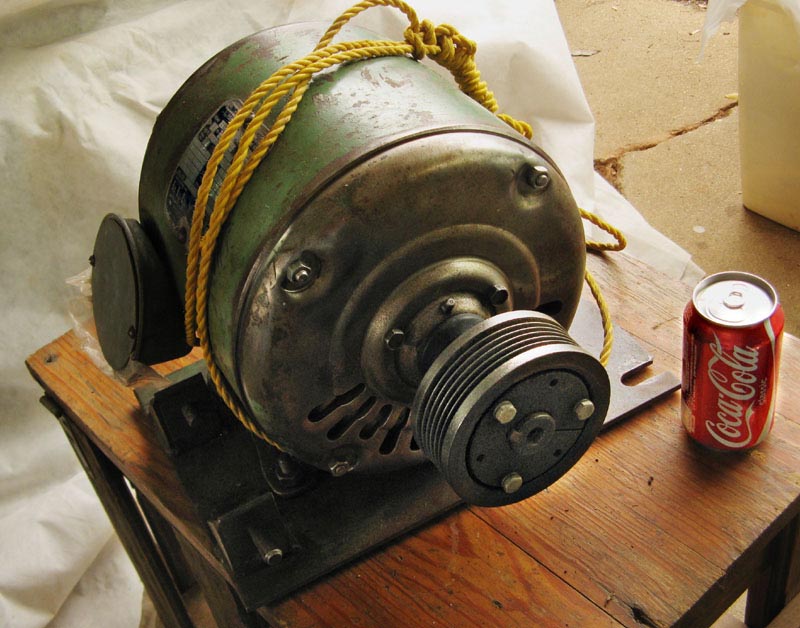
Running my 3HP 3-PHASE MOTOR from household AC
using capacitors.
WARNING: These
methods involve lethal voltages (lethal means you die). The wiring discussed probably violates
code. I take no responsibility for your
pain, injury, fines, and loss of life. /WARNING
To run a 3-PHASE MOTOR from 2-phase AC, you first connect the line across 2 phases from the motor. The empty phase needs to be fed via capacitors from BOTH the 1-phase lines. This is not a 120deg phase shift from each line because they are 180 deg to begin with, so the ideal capacitance values will not be equal, but it's easy to find values that work. Equal capacitors would be balanced, and yield no starting torque. To keep it simple, you can energize the third phase from just a single capacitor just for starting, and run (with less power) with just two phases energized and the capacitor disconnected.
MOTOR & AC BACKGROUND
GETTING ROTATION STARTED: Our AC (Alternating Current) alternates so that a terminal is positive and then flips to negative half a cycle later (one-half of 1/60th second later). If you make an electromagnet to turn a motor using this current, the magnetic pole will be "North" and flip to "South" 1/120th of a second later. Motors work by taking the part that rotates and pulling (attracting) it around in a circle with a magnetic field. But a single magnetic field that only reverses is only good for pulling the motor rotor up one moment and down the next, not round and round. This is why all our motors have some kind of complexity to get them started -- a capacitor inside the bump on top of a "capacitor start motor", or a special starting winding that you can hear being switched in and out as the motor gets up past the starting speed.
RUNNING
ON FLIP-FLOP 2-PHASE: Once up to speed, a conventional home-AC
(2-phase) motor will keep running. When one cycle is
finished, one rotation is finished, and the basic speed is thus 3,600
rpm (60 cycles or rotations/second x 60 secs/min). When running
at speed, the moving part chases the magnet at 12:00 o'clock that has
the north pole, overshoots and starts around towards 6 pm (the bottom
position), getting a strong pull
to "hurry up" and get to 6 PM because -- presto! -- now the north pole
is there. That pull adds torque (force) to the rotation, and the
torque-adding tug will be repeated again at 12 o'clock (top) if the
rotor doesn't hurry. But, with no tricks to get it started in the
first place, any AC motor rotor will point (lock) straight at one pole
and sit there buzzing until someone turns it off, or the
electromagnets' copper windings burn out. Most motors have four poles,
not two like this example, and so their synchronous speed is 1800 rpm,
not 3600. Little electric clock motors work this way.
Bigger, fractional-horsepower induction motors -- induced magnetism in
the rotor, not real magnets -- have "slip" and turn at around 1725
rpm, not synchronously at 1800 rpm. The poles of the induced
magnet are spread out to reduce vibration at the higher powers
involved, but strict synchrony is lost.
THREE-PHASE: Three-phase power comes on three separate wires, plus the 4th common return ("ground", "neutral"). Each is reversing 60 times a second (60 Hz AC), but the magic is that each reaches its peak 1/3 of a cycle (1/3rd of the way around a circle) later than the one before. The rotor of a three-phase motor will be pulled around the circle -- no matter where it is sitting, and regardless of whether it is started or not. So: 3-phase motors have tremendous starting torque. A two-phase motor can be stopped and restarted in the opposite direction, but a three-phase motor can be commanded to reverse while running. It is easy to implement electronic braking (e.g., by shorting the windings through diodes).
Bottom
line: with woodworking machinery, 3-phase motors offer the ability to
stop quickly, check the work, and restart quickly. They have more
torque at any speed and always restart at once if stalled. This is a klutz-friendly motor.
FOR THE UNEQUAL CAPS TRY THESE uFD SIZES
4-5x motor
HP for one line
For my 3HP
motor, this is 3 *4 = 12uFD. And then,
10-15x HP
for the other AC line-> 30uFD
USING
PAIRS OF CAPS ON AC: Use pairs of capacitors back-to-back (not
head-to-tail). All electrolytics have a positive pole because
they only work on DC (the current always goes one way). So the
back-to-back connection of plus/minus--minus/plus means that one
capacitor is always connected the right way as the AC current
alternates its polarity. That way, one capacitor can always fill
up to whatever its rated capacity (capacitance) is, and resist further
current flow, while the other would have been screwed by that
direction of current-voltage pressure, if the partner hadn't stopped
it. In short, two back-to-back, ordinary (i.e., DC) electrolytic
capacitors make one AC capacitor.
For the motor, the capacitors are optimal when 1) vibration is minimal, and 2) the voltage between
all phases is most nearly equal. It is
possible that the optimal amount of capacitance changes with motor load -- I
don't know yet. This is the best “el
cheapo” way to run a single 3-phase motor – max HP, minimum buzz and
vibration.
Parallel connections sum
capacitances, but the lowest rated voltage (the weakest link on the
chain) is the one that has to be good enough.
High-quality electrolytics last 30 years. As electrolytics age (“dry out”), their capacitance may drop—if you don’t have a capacitance meter, the motor’s vibration will tell you the capacitance you expected isn't all there. You can add some more capacitors in parallel to top things back up again. Old capacitors can also “leak” more current, which makes them warm, which dries them out faster. Not a big deal – once you know that the capacitor can has no leakage voltage on it, you can feel the temperature with your hand a couple times a year. If it ever feels different, order a new one.
For
simplicity (fewer capacitors) and for less vibration -- but less HP -- start on 3
phases but run on two. .
A 3-phase
motor can be run without any capacitors on just 2 phases once you get it
started. Do whatever you want to start the
motor spinning. Above, I discussed a starting
capacitor temporarily connected to the third (empty) phase, but some home
workshop people use a spare run-of-the-mill second motor to initially spin up a
big 3-phase motor before turning on its power.
In these
home shop setups, once started, this first motor typically acts as a 2-to-3-phase (rotary-type) converter for all the other (3-phase) motors
in the shop. The other motors
are no bigger than 2/3rds the HP of the rotary conversion motor (2 out of 3
phases energized; 2/3rds power available). Only one shop machine
is run at a time. People do this for two
reasons: once you have real 3-phase current from the conversion motor, all the other 3-phase motors on the shop
tools have enormous starting torque, and it’s easy to install switches that
give electrical braking. If you are
doing demanding turning on a big wood lathe, this translates into easily
stopping to look carefully at the work, then instantly starting back up again to
continue the cut. The second reason is
that people give these motors away free because no one can figure out how to
run them. Sometimes it's easier to collect free motors than free capacitors -- whatever works for you.
Rev 22May09
Rev 31May2018, Found a photo of my dear old motor.
OMG, I
got the phase and frequency wrong -- fixed that.
Explain basic RPM is 3600, 4 poles divide it down to 1800,
blurred pole structure lets 1800 rpm motor slip out of synchrony to
17hundred-something.
Still more errors? jerry_stillstanding@nelsonic.org
Did you use one of these for a wood-turning lathe and make anything
pretty?
-----------------------------------------------------